
Porto
Porto Cathedral (Sé do Porto)
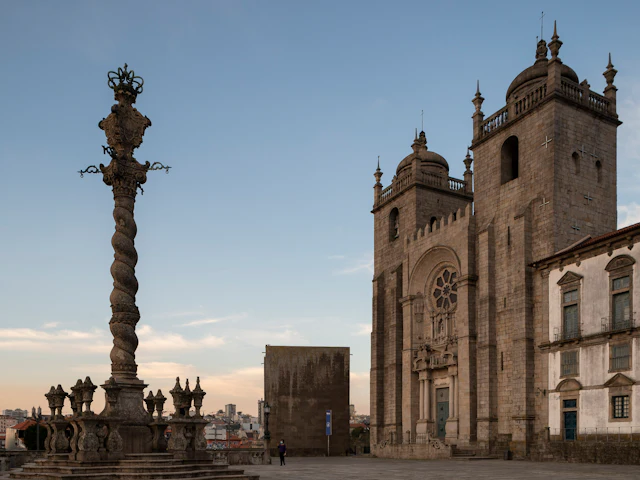
Porto Cathedral looks down on the Ribeira from its hilltop, with two square towers and battlements along the front. Its Gothic cloister is lined with great panels of blue-and-white tiles, and the tower looks over the old town's roofs to the Douro. In 1387 King João I married an English princess here. It's included in all four Porto passes.
Before you go
- Time inside30 min – 1 h
- Weekly closingNone


A walk round Porto Cathedral, from the chapels to the tower
Inside, the church comes first, then the cloister and the museum, with the tower to finish.
The nave and the main chapel

You go in under a 12th-century rose window, and the narrow nave rises to a stone barrel vault.
Up at the far end, the main chapel dates from 1610, in the Mannerist style that came between the Renaissance and the Baroque. Its gilded Baroque altarpiece is from the second quarter of the 18th century, and Nicolau Nasoni, the Tuscan-born painter who later built the Clérigos Tower, painted the walls around it.
On the way back, look into the Blessed Sacrament chapel for its silver altar. Local tradition says a sacristan once hid it under a coat of plaster.
The Gothic cloister and its tiles

The cloister is Gothic, begun at the end of the 14th century. Its walls carry seven azulejo panels, Portugal’s painted tiles, from the same decades as the main altarpiece, with scenes from the Song of Songs, the love poem of the Old Testament.
From the cloister, a staircase that Nasoni added in 1736 climbs to the upper floor, where a terrace looks over the roofs of the Ribeira, Porto’s riverside quarter, to the river.
The tower

It’s stairs all the way to the top. Someone who climbed it in October 2026 found the steps high but the climb easier than at the Clérigos, with a view that swings round about 270 degrees.
Across the river you look onto the Dom Luís I Bridge and the Serra do Pilar monastery, on the hill in Gaia.
Nasoni’s galilee and the Terreiro da Sé

On your way out, look for Nasoni’s other work from 1736, on the side of the cathedral: the galilee, a porch of arches lined with blue-and-white tiles.
The Terreiro da Sé, the big square in front, is a viewpoint of its own over the rooftops and the river, and it costs nothing. The Bishop’s Palace stands on it too, next to an old stone pillory.
Porto Cathedral tickets, hours and passes
One ticket covers the cathedral, the cloister, the museum and the tower. It comes with any of the four Porto passes, from €29.50, or you can buy the cathedral ticket alone for €4, and students pay €3.
In the Highlights Pass, the cathedral comes with the Clérigos Tower and a cruise under the bridges. The Explorer pairs it with a fado show and two days on the hop-on bus, which also takes in a river cruise and a port cellar.

- Open
- Every day, 9:00–18:30 in summer and 9:00–17:30 in winter; the cathedral doesn't give the dates of each season
- Closed
- Christmas and Easter
- Mass
- Daily at 11:00
- Children
- Free up to age 10
- Tower
- Stairs only, with no access for reduced mobility
Tickets aren’t for a set time, but visitors in 2026 still queued at the desk for 10 to 30 minutes. Some who had bought online had to have their phone ticket validated there too.
Midday can be “quite chaotic”, as one reviewer put it, so come early or late. And with mass at 11:00, see the church before or after it.
The royal wedding and the rebuilding of Porto Cathedral
Porto Cathedral was begun in the 12th century on its hill above the river, and the building went on for centuries after that.

Its great day came in February 1387. King João I married Philippa of Lancaster, an English princess, to seal the Treaty of Windsor of 1386 between Portugal and England, the oldest treaty still in force.
The couple were first blessed on 2 February, and the full ceremony followed here on 14 February, after the city had spent two weeks dressing itself up for it.
Seven years later their son Henry, the future Navigator, was born in Porto, a few streets down the hill at Casa do Infante, if tradition is right.
Much later, in the 1930s, the whole building went through a major restoration, and Porto’s tourist office calls the result an idealised reconstruction of a medieval cathedral.
Below Porto Cathedral: the Bolsa and the quay
The cathedral is about seven minutes’ walk up from São Bento station. Below it, the old streets of the Ribeira run down to the Douro, past the Bolsa and São Francisco.
Down to the river
-
 Bolsa Palace → About eight minutes down. Tours are guided only, so get your time at the desk and carry on while you wait. €14
-
 Church of São Francisco → Next door to the Bolsa: a plain Gothic church, all gilded carving inside. €12
-
 Douro River Cruise → On the quay itself, where the Highlights Pass gets you onto the Six Bridges cruise.
€20
City passes
Porto city passes
Pick the one that fits your trip. Prices are per adult, and you choose your dates on the next page.


Tickets
Popular tickets around Porto
The ones other visitors book most.


