
Lisbon · Included with the card
Belém Tower
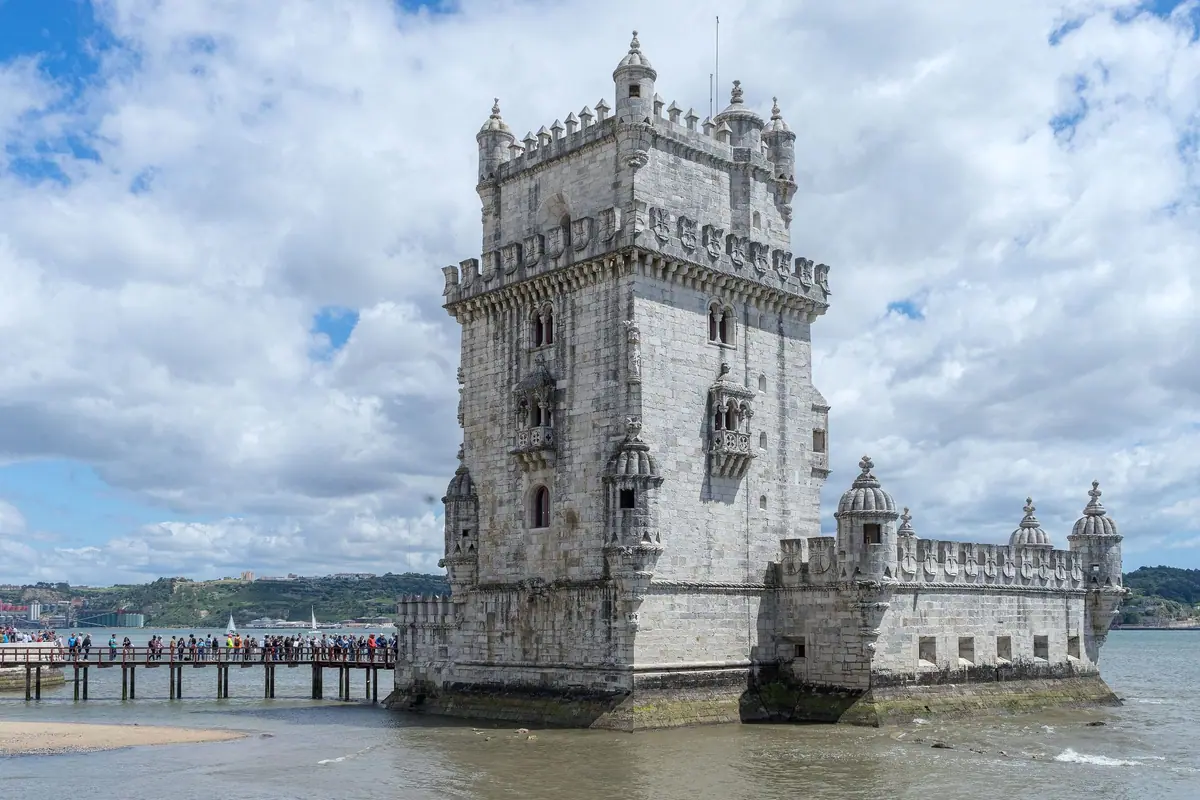
Belém Tower, the emblem of Lisbon, was built in the river, on a rock a couple of hundred metres off the shore, where it caught the eye of ships sailing in. Its stone shows knotted ropes, ribbed domes and a rhinoceros. Fernando Pessoa, one of the great modern poets, called it lace. It's included in the Lisboa Card.
Before you go
- Time inside30 min – 1 h
- ClosedMonday
- EntryTimed slot
- Best timeLate afternoon
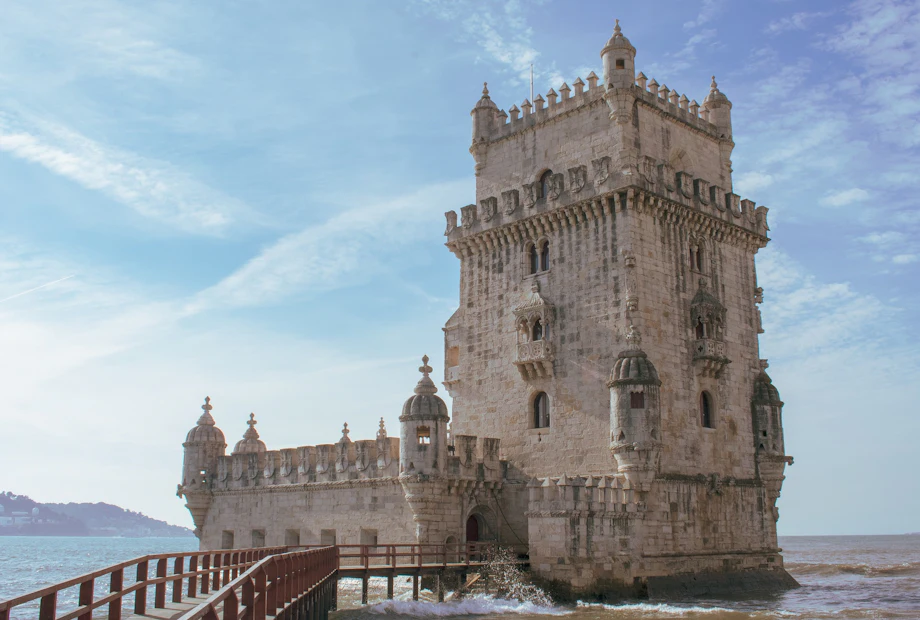


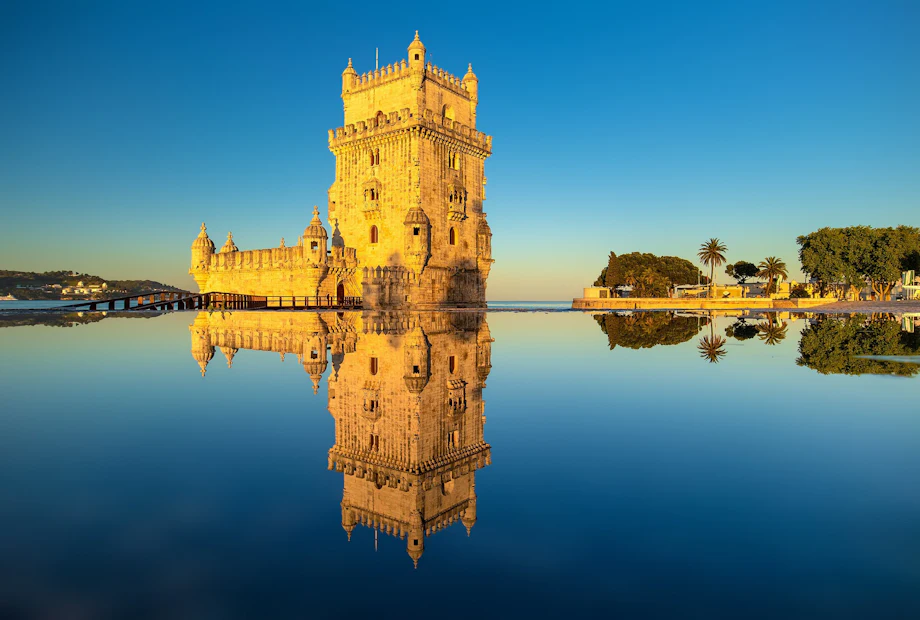

Belém Tower, outside and in
The carving is on the outside, so walk round the tower before your time slot. Inside, the visit climbs from the bulwark through four rooms stacked one above the other.
The rhinoceros on the west turret

Head for the west side of the bulwark, the low platform in front of the tower, and look at the foot of the corner turret. That stone head is a rhinoceros.
The real one reached Lisbon in May 1515 after four months at sea, a gift from a ruler the monument calls King Modafar to Afonso de Albuquerque, the Portuguese governor in India. Nobody in Europe had seen a rhino since the 3rd century.
The news travelled fast: the German artist Albrecht Dürer drew it that same year from written descriptions, without ever seeing it. Its next voyage, as a royal present for Pope Leo X, ended when the ship sank in a storm off Genoa.
The domed turrets and Manuel I’s emblems

From there, look up at the turrets. The monument itself sees Eastern influences in their ribbed domes, and Moorish touches elsewhere on the building. On the land side, St Michael and St Vincent, Lisbon’s patron saint, stand over them.
The style is Manueline, named after Manuel I, who carried on King João II’s plan and had the tower built as Portugal grew into a world power. A stone rope tied in knots runs right round the building, and the turrets are crowned with Manuel’s emblem, the armillary sphere, a globe made of rings.
Higher up, crosses of the Order of Christ, a Portuguese order of knights, line the battlements of the tower. On the river side, a loggia of seven arches opens from the second floor, under the king’s coat of arms.

That’s the face ships saw as they arrived, and the court used the balcony for ceremonies when the fleets sailed out and came home.
The bulwark and the four rooms above

Inside, you start in the bulwark, whose 17 gun ports sit just above the waterline, for cannon fire that skimmed across the water. So the tower is two forts in one, an old-style keep on a modern gun platform, built as gunpowder took over from catapults.
Up on the bulwark terrace, a niche facing the river holds Our Lady of Good Success with the Child, also known as the Virgin of the Grapes.
From the terrace a spiral stair climbs the tower, one room per floor. First comes the Governor’s Room, with an octagonal well that drew on the cistern. The King’s Room above it has a fireplace and three Venetian-style windows that open onto the loggia.
Higher still, the Audience Room keeps its stone window seats and a three-colour chequered floor. At the top, the chapel’s rib vault carries the sphere, the cross and the royal arms, over a black-and-white floor with a black octagon in the middle.

There aren’t many rooms, and visitors in 2026 spent between half an hour and an hour inside.
Booking Belém Tower: tickets, slots and hours
With the card or without it, you go in at a set half-hour slot. The carving outside you can see from the lawn and the riverside path.
- Open
- Tuesday to Sunday, 9:30–17:30, last entry 17:00
- Time slots
- Every half hour; the last one starts at 16:30
- Closed
- Mondays, 1 January, Easter Sunday, 1 May, 13 June (Lisbon's city holiday), 25 December
- Children
- Free up to age 12
- Half price
- Over-65s, ages 13 to 24, and family tickets (family only at the ticket office)
The Lisboa Card, from €31, covers the tower and the train out to Belém; without it, the ticket is €16.80.
Card holders get their own share of the slots, and it can run out, so book as soon as your Belém day is fixed. You book on the monument’s ticket site with the number printed on the physical card.
That means a voucher has to be swapped for the card at one of the Ask Me Lisboa tourist offices first. Changing a slot needs 24 hours’ notice.


Without the card, buy early too. The monument says tickets often sell out, and then there’s nothing left to buy on the day.
The director told the Lusa news agency the wait outside should be 20 minutes at most, though some visitors in 2026 report longer lines. For quieter rooms, two of them recommend opposite ends of the day, the first slot and the last.
Suitcases, trolleys, big backpacks, tripods and selfie sticks are all banned inside, and so are food and drink. The monument doesn’t provide audio guides, and in bad weather it can close the tower for safety.
Pushchairs and wheelchairs can’t go onto the bulwark terrace, and step-free access ends on the ground floor.
Why Belém Tower was built in the river
Belém Tower was one of three defences at the mouth of the Tagus. Together with the fortress at Cascais and the Torre Velha on the south bank, it caught ships in crossfire.
Its architect, Francisco de Arruda, was a fortress specialist who’d worked in Morocco and India with his brother Diogo. Here he answered to Diogo de Boitaca, the architect then building Jerónimos Monastery, and by 1519 the tower was all but finished.
Back then it stood on a basalt rock 200 to 250 metres off the shore. People will tell you the 1755 earthquake moved the river.
The monument’s own explanation is slower. The Tagus silted up, helped by the tower itself, which trapped the sand like a breakwater, and by the 19th century the rock was practically joined to the land.
In those centuries its damp cellar, the old powder store, held political prisoners. Most were jailed under Philip II of Spain, who was also king of Portugal from 1580, and later under João IV, king from 1640.
Milestones
- 1589 to the early 1800s
- Soldiers' barracks on the bulwark terrace
- 1846
- Queen Maria II has it restored, with the Duke of Terceira in charge
- 1907
- National Monument
- 1983
- UNESCO World Heritage Site
- 27 May 2026
- Reopens after its first deep restoration since 1998
That last restoration cost about a million euros from Portugal’s recovery plan. The restorer said nobody remembered a cleaning like it inside the tower in 500 years, and the armillary spheres and shields can be made out again.
Walking east from Belém Tower
Belém’s other monuments all lie east of the tower, so the walk follows the river the way the ships sailed in. From Cais do Sodré, the Cascais-line train gets to Belém in about 8 minutes and tram 15E takes about 30 from Praça da Figueira, both on the Lisboa Card.
An afternoon east of the tower
-
 Monument to the Discoveries → East along the water, about 10 to 15 minutes on foot. No slot to book, and it opens on Mondays.
€10 -
 Jerónimos Monastery → Across the road and the railway from the Padrão. Its cloister needs a booked time as well.
€19.50 -
 Pastéis de Belém A few minutes east of the monastery on Rua de Belém. Order the custard tarts, baked here since 1837 by the house's account.
Card and combos
Lisboa Card options
Pick the one that fits your trip. Prices are per adult, and you choose your dates on the next page.


Tickets
Popular tickets around Lisbon
The ones other visitors book most.


