

Lisbon · −20%
Lisbon Cathedral (Sé de Lisboa)
Lisbon Cathedral looks like a fortress, with two towers either side of its rose window, and it's the oldest church in the city today, begun around 1147. Inside, from the high choir you see the whole nave, and the Treasury keeps the relics of St Vincent, the city's patron saint. The Lisboa Card takes 20% off.
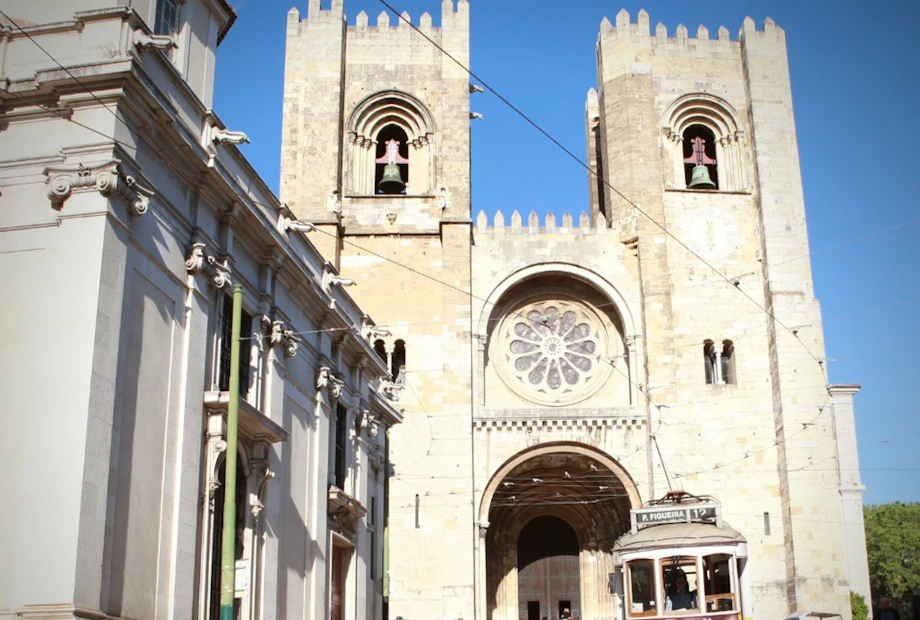


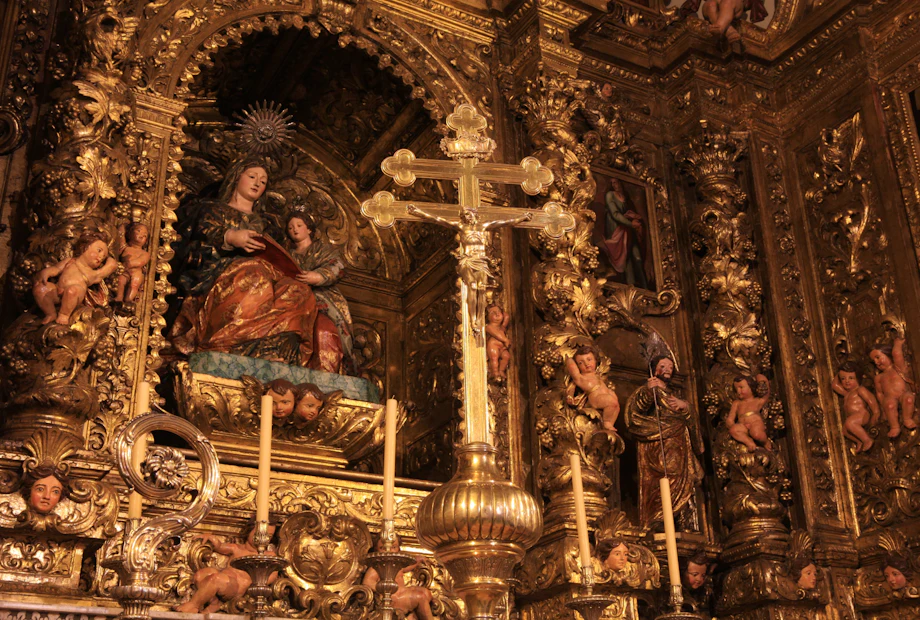


Lisbon Cathedral’s high choir, nave and chapels
Visitors describe a circuit that begins with a climb, up the stairs to the high choir over the entrance. Then come the nave, the chapels round the back and, since May 2026, the baptistery.
The high choir and the rose window

On the way up, look at the staircase wall for the cross St Anthony is said to have drawn there as a boy, to keep the devil away. The world knows him as St Anthony of Padua, but he was born a few steps from the cathedral in the 1190s and baptised in it.
At the top, the high choir looks down the whole central nave to the main chapel. It only dates from 1952, built on concrete beams, and from it you also go out onto the balcony between the bell towers.
The rose window’s glass is from the 1930s, with the twelve Apostles around Christ the Saviour. It went in when the window was remade, in the restoration of the early 20th century.
The Romanesque nave and the Gothic ambulatory

Back downstairs, walk up the Romanesque nave and round the ambulatory, the Gothic passage behind the main chapel. Nine chapels open off it, under pointed stone vaults built in the time of the Portuguese kings Afonso IV and João I.
Two of those chapels are worth a stop. The chapel of Bartolomeu Joanes has Renaissance paintings of the life of Christ and the Gothic tomb of a medieval Lisbon merchant.
In the chapel of Saints Cosmas and Damian lie two 14th-century Gothic tombs: Lopo Fernandes Pacheco, who fought alongside Afonso IV, and his second wife, Maria Vilalobos.
The baptistery, the newest part of the ticket, is lined with 18th-century tile panels.
St Vincent’s ravens and the Lisbon Cathedral Treasury
One of the Treasury’s most important pieces is the reliquary of St Vincent, an early Christian martyr. Afonso Henriques, Portugal’s first king, had promised to bring his bones to Lisbon if he took the city.
The relics arrived on 16 September 1173, and the legend says two ravens guarded the boat all the way. The boat and its ravens became symbols of the city, and they’re still on Lisbon’s coat of arms.
St Vincent’s chalice and paten, the cup and plate used at Mass, are on show too. Of the Treasury’s four rooms, one holds relics and reliquaries, one vestments for the church year and one books from the music archive.
The fourth, the Chapter Room, is an 18th-century hall built over the 17th-century sacristy. Lisbon’s archbishop carries the title of patriarch, and here are the patriarchs’ tiara, the chair they were carried in and a ceremonial fan.
Alongside them is the Gold Monstrance of the Patriarchate, the vessel for showing the consecrated host.
Lisbon Cathedral tickets, opening hours and Sundays
Since 18 May 2026 a visit to the cathedral takes a ticket. It covers the whole circuit: the high choir, the balcony between the towers, the Treasury, the naves and ambulatory, and the baptistery. Entry to the Blessed Sacrament chapel, kept for prayer, is free.
- Open for visits
- Monday to Saturday, 10:00–18:00
- Longer hours
- 9:30–19:00 in summer: Mondays, Tuesdays, Thursdays and Fridays from May to October, or Monday to Saturday from April, depending on which of the cathedral's pages you read
- Last entry
- 30 to 45 minutes before closing (the cathedral's pages differ)
- Mass
- Tuesday to Thursday at 17:30, Sunday at 11:30; visits pause during services
- Closed
- 25 December and 1 January
- Children
- Free up to age 6; ages 7 to 12 pay €5
You can buy the adult ticket online for €7 and go in any time during opening hours. The Lisboa Card, €31 for a day, takes 20% off, and at the cathedral’s own desk card holders pay €5.


Sundays are the grey area. The visiting rules the cathedral published in May 2026 let anyone into the interior without a ticket on Sundays, from 9:30 to 17:00.
The cathedral’s timetable page still lists Sundays and holy days as closed, though, and the rules don’t say whether the choir and the Treasury open. A visitor in September 2026 found it open, with free entry.
Inside, visitors find the cathedral quiet even when the square is busy, and one got round the whole circuit in under an hour. They also warn that the stairs at the start are steep and rule out wheelchairs.
Between July and September 2026 some found parts of the cathedral fenced off for works.
Sé Digital, an AI audio guide on your phone in six languages, English among them, costs €3 more. The cathedral’s own guides give tours in English, Portuguese, Spanish or Italian, booked ahead, at €40 for a group of up to 25.
Lisbon Cathedral’s history and the St Anthony weddings
When Afonso Henriques took Lisbon in 1147, an English crusader, Gilbert of Hastings, was made its bishop. Work on the cathedral probably began that same year, in the Romanesque style, on a Latin-cross plan.

Six centuries later, the 1755 earthquake destroyed part of the building: the Gothic main chapel, the Blessed Sacrament chapel, the roof of the nave, the south tower and the lantern tower. Restorations in the early 20th century gave it a medieval look again, and it reopened in 1940.
St Anthony still brings couples here. Lisbon’s St Anthony weddings, group weddings first held on 12 June 1958, pair a civil ceremony at City Hall with a religious one in the cathedral. They stopped for 23 years after the 1974 revolution and came back in 1997.
Behind the church is a Gothic cloister, begun under King Dinis, Portugal’s king from 1279. It has been closed for works since 2018 and isn’t part of the visit.
Digs there since 1990 have turned up a Roman street and a large 12th-century Islamic building. Tradition says the cathedral went up on the site of the city’s main mosque, but specialists consulted in 2021 found no evidence that this building was part of it.
From Lisbon Cathedral up to the castle and down to the river
The cathedral stands on Largo da Sé, where the flat Baixa starts climbing into Alfama. Bus 737 runs up to the Castelo stop, two minutes from the castle gate, and the Lisboa Card covers it.
Castle first, then the Baixa
-
 São Jorge Castle → Up through Alfama on foot, or on bus 737, for the walls and the view over the whole city.
€17 -
 Rua Augusta Arch → Back down through the Baixa, for the view straight up Rua Augusta from the roof.
€5 -
 Lisboa Story Centre → On Praça do Comércio as well, run by the same team as the arch.
€8
Card and combos
Lisboa Card options
Pick the one that fits your trip. Prices are per adult, and you choose your dates on the next page.


Tickets
Popular tickets around Lisbon
The ones other visitors book most.


