

Lisbon · Included with the card
Rua Augusta Arch (Arco da Rua Augusta)
From the top of the Rua Augusta Arch you look straight up Rua Augusta into the Baixa, Lisbon's downtown. Turn round and Praça do Comércio opens onto the Tagus, with the arch's own sculptures in view. Going up is included in the Lisboa Card.

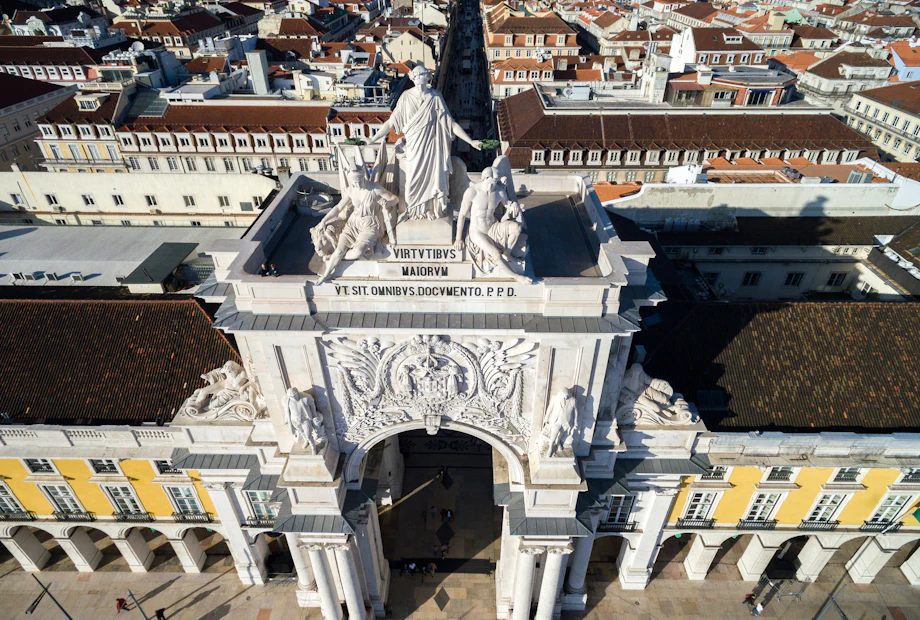


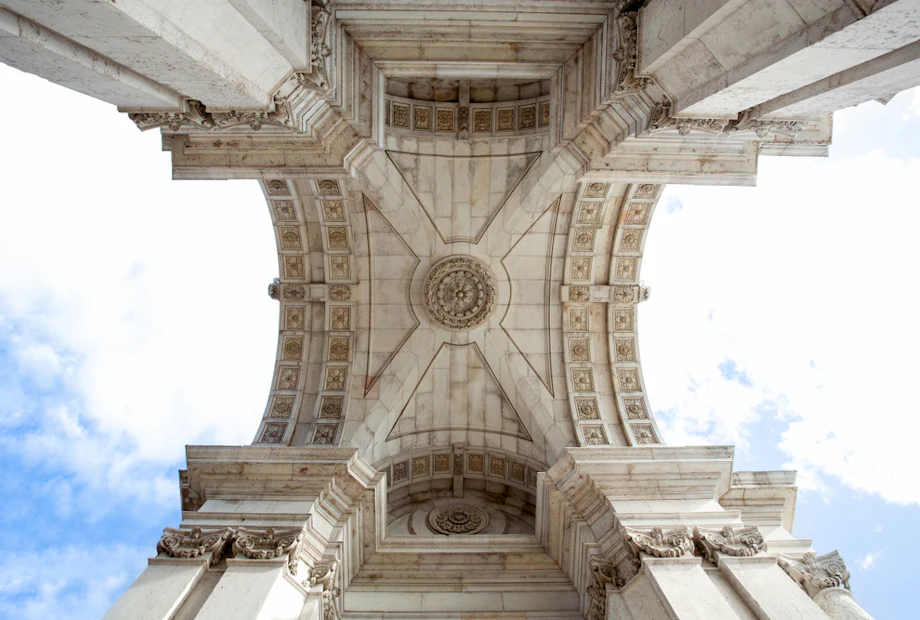
Up the Rua Augusta Arch: the Clock Room and the roof
The way in is a small door at the side of the arch, at Rua Augusta 2, and visitors say it’s easy to walk past.
A lift takes you to the second floor, and from there it’s 74 steps, up narrow stairwells, to the roof. The visit also takes in the Clock Room, whose exhibition follows the arch from the first work after the 1755 earthquake to the finish in 1875.
At the top the view goes all the way round, over the Baixa and the river, and Rua Augusta runs straight into the grid of streets rebuilt after the earthquake.

From the roof you also see the group that crowns the arch, Glory crowning Genius and Valour, by the French sculptor Célestin Anatole Calmels.

The Rua Augusta Arch from the street
Back on the street, walk down Rua Augusta to the arch if you can. As you pass under it, the square and the river open up in front of you, and that’s the moment visitors single out.
Below the group that crowns the arch stand four statues by Vítor Bastos. One is the Marquis of Pombal, the king’s minister who rebuilt Lisbon after the earthquake, and another is the navigator Vasco da Gama.
The other two are Viriato, who led the Lusitanians of the western Iberian Peninsula against Rome, and Nuno Álvares Pereira, a general in Portugal’s wars against Castile in the 1380s. Above them, a Latin inscription honours the virtues of the ancestors.
Arco da Rua Augusta tickets and the climb to the top
The arch spans a public street, so walking through it costs nothing; you only pay to go up, and you can buy the ticket at the door.
- Open
- Every day, 10:00–19:00
- Last entry
- 18:30
- Closing days
- None published; whether it opens on Christmas Day and New Year's Day isn't confirmed
- The climb
- Lift to the 2nd floor, then 74 steps
- Children
- Free up to age 5
The ticket to the top costs €5. With the Lisboa Card, €31 for 24 hours, the climb is included and the arch’s souvenir shop takes 10% off.


Nobody in the past year’s reviews complained of a queue to go up, and one visitor timed the whole visit at 10 to 15 minutes.
Some visitors go up for the sunset. For photos of the square with hardly anyone in it, others suggest 8:00 to 9:00, before the arch opens.
The stairs are steep and narrow, and reviewers warn they’re hard going with limited mobility.
The Rua Augusta Arch and the rebuilding of Lisbon
The arch belongs to the rebuilding of Lisbon after the 1755 earthquake, and the city’s tourist board describes it as a symbol of that recovery.
It was already sketched, as a triumphal arch, in the architect Eugénio dos Santos’s 1759 plan for the new Baixa, the downtown rebuilt under Pombal.
Work began, then stalled, and only in 1843 did a competition pick the design of Veríssimo José da Costa. The arch was finished in 1875, more than a century after the first plan.
In 1910 it was classified as a National Monument, as part of Praça do Comércio. The roof opened to visitors on 9 August 2013.
Around the Rua Augusta Arch: the square, the Sé and the castle
The nearest metro is Terreiro do Paço, on the blue line, and the cathedral and the castle are both uphill from here.
Up from the river
-
 Lisboa Story Centre → Across Praça do Comércio, and included in the card as well.
€8 -
 Lisbon Cathedral → Uphill to the east. Look for the cross St Anthony is said to have drawn as a boy, by the stairs to the choir. €7
-
 São Jorge Castle → At the end of the climb, with the camera obscura and the wall walks.
€17
Card and combos
Lisboa Card options
Pick the one that fits your trip. Prices are per adult, and you choose your dates on the next page.


Tickets
Popular tickets around Lisbon
The ones other visitors book most.


