

Lisbon · Included with the card
Jerónimos Monastery
Jerónimos Monastery is the high point of Manueline, Portugal's lavish late-Gothic style, and the country's most visited monument. Its cloister is carved like lace, and the church holds the tombs of Vasco da Gama, who opened the sea route to India, and the poet Camões. The church is free to enter; the cloister is included in the Lisboa Card.
Before you go
- Time inside45 min – 1 h
- ClosedMonday
- EntryTimed slot
- Best timeMornings


The Jerónimos cloister and church
Start in the cloister, the part everyone photographs. Then save some time for the two rooms off it that are easy to miss, and for the church, where Vasco da Gama is buried.
The cloister

Diogo de Boitaca, the first architect on the job, planned it and finished the ground floor. Diogo de Torralva completed the upper gallery in 1540 and 1541, after João de Castilho’s years in charge.
You can see the change of hands. Below, the arches are busy Manueline work; above runs a calmer Renaissance parapet with Roman-style medallions.
Then stand in a corner and look across. The inner corners are cut off at an angle, so the square reads as an octagon. Manuel I’s emblems run through the carving: the armillary sphere, the globe of rings that’s still on the Portuguese flag, and the cross of the Order of Christ.
Most of the ropes, anchors and sea creatures people zoom in on are 19th-century, by the way. They went in during the restoration, carved in the same style.
As for getting around, you walk both galleries but not the garden in the middle. The upper gallery is up a flight of stairs, with no way up for wheelchairs or pushchairs.
The chapter house and the refectory

Two rooms open off the cloister, and it’s easy to walk straight past both.
The first, the chapter house, was built for the monks’ meetings but never used for them. It was only finished in the 19th century, to hold the tomb of the historian and novelist Alexandre Herculano.
Next door, the refectory is where the monks ate. Its lower walls are lined with 18th-century tiles telling the story of Joseph, and the panel by the door shows the miracle of the loaves and fishes.
Fernando Pessoa’s tomb

Fernando Pessoa is one of the great poets of the 20th century. He wrote under several invented names, the heteronyms, each signing different work.
Fittingly, his tomb by the sculptor Lagoa Henriques, in the north gallery of the ground floor, carries lines by four of those names: Caeiro, Reis, Campos and Soares. He was moved here in 1985, fifty years after he died.
The church: Vasco da Gama, Camões and the kings

Before you go in, look at the south portal on the river side, carved by João de Castilho in 1517–18. The figure between its two doorways is Henry the Navigator, the prince who started Portugal’s voyages of discovery.
Once inside, you’ll notice the three aisles rise to the same height under one stone vault, so the church feels like a single huge room.
Just past the entrance, under the choir, Vasco da Gama lies on the left. On the right is Luís de Camões, Portugal’s national poet, whose The Lusiads (1572) tells the story of Gama’s voyage.
Both tombs are 19th-century, and here’s the twist: Camões’s may not hold Camões. In 1854 a commission went looking for his bones in the church where he’d been buried. It said some were his but couldn’t tell which, and what it found came here in 1880.
Further in, in the chancel, the Portuguese kings Manuel I and João III lie with their queens, on tombs carried by marble elephants: a nod to India.
Jerónimos Monastery tickets, queues and opening hours
Entry to the church is free. The cloister, with the chapter house and the refectory, needs a ticket, and that ticket is included in the Lisboa Card.
- Cloister
- Tuesday to Sunday, 9:30–17:30, last entry 17:00
- Church
- Free. Tuesday to Saturday 10:30–17:00; Sundays and religious holidays 14:00–17:00
- Ticket office
- Closes at 16:30
- Children
- Free up to age 12
- Closed
- Mondays, 1 January, Easter Sunday, 1 May, 13 June (Lisbon's city holiday), 25 December
You can get the Lisboa Card for €31, or the cloister ticket on its own for €19.50. Buy ahead if you can: on busy days tickets sell out, and then there are none left at the door.


Even with the card you still need a time slot, which is free. You book it with the number on the physical card, so the email voucher won’t do: collect the card at an Ask Me Lisboa tourist desk first. Card holders have their own daily quota, and in high season it runs out.
Whichever you buy, a booked time won’t get you past the queue, and in summer you’ll wait in full sun. The monastery itself warns that on busy days the wait can pass two hours.
So with an ordinary queue, allow an hour and a half to two hours door to door. From Tuesday to Saturday you can do the cloister from 9:30 and the church from 10:30 in the same morning.
And leave big bags and backpacks at the hotel: they’re not allowed in, and neither are food and drink. There are no audio guides either.
How Jerónimos Monastery came to be
Before the monastery there was a small chapel on this shore, which Henry the Navigator had enlarged in 1459. Gama kept vigil there on 7 July 1497 and sailed the next morning.
Three years later Pedro Álvares Cabral sailed from the same beach, on the voyage that reached Brazil. Soon after, Manuel I, the king who’d sent Gama, replaced the chapel with something far bigger.

The works began in 1501 or 1502, paid for, the story goes, with a 5% tax on spices from India. The monks of the Order of Saint Jerome then gave the monastery its name.
They stayed for more than three centuries. In December 1833 the state took the monastery and gave it to the Casa Pia, a charity school, which kept it until 1940.
Next to the church, the long wing on the west side looks just as old but is 19th-century. It houses the National Archaeology Museum, on the Lisboa Card’s list but closed for renovation.
Since 1983 the monastery has been a UNESCO World Heritage Site, together with Belém Tower, and in December 2007 the leaders of the European Union signed the Treaty of Lisbon here.
Belém after Jerónimos
Getting here is easy. Tram 15E takes about half an hour from Praça da Figueira, and the train from Cais do Sodré about 8 minutes, plus a short walk. Both are included in the Lisboa Card.
Once you’re there, the rest of Belém is on foot along the river.
After the monastery
-
 Pastéis de Belém A few minutes east along Rua de Belém. Custard tarts made to the same recipe since 1837: eat them warm.
-
 Monument to the Discoveries → Across the road and the railway, on the river. Take the lift up for the compass rose below.
€10 -
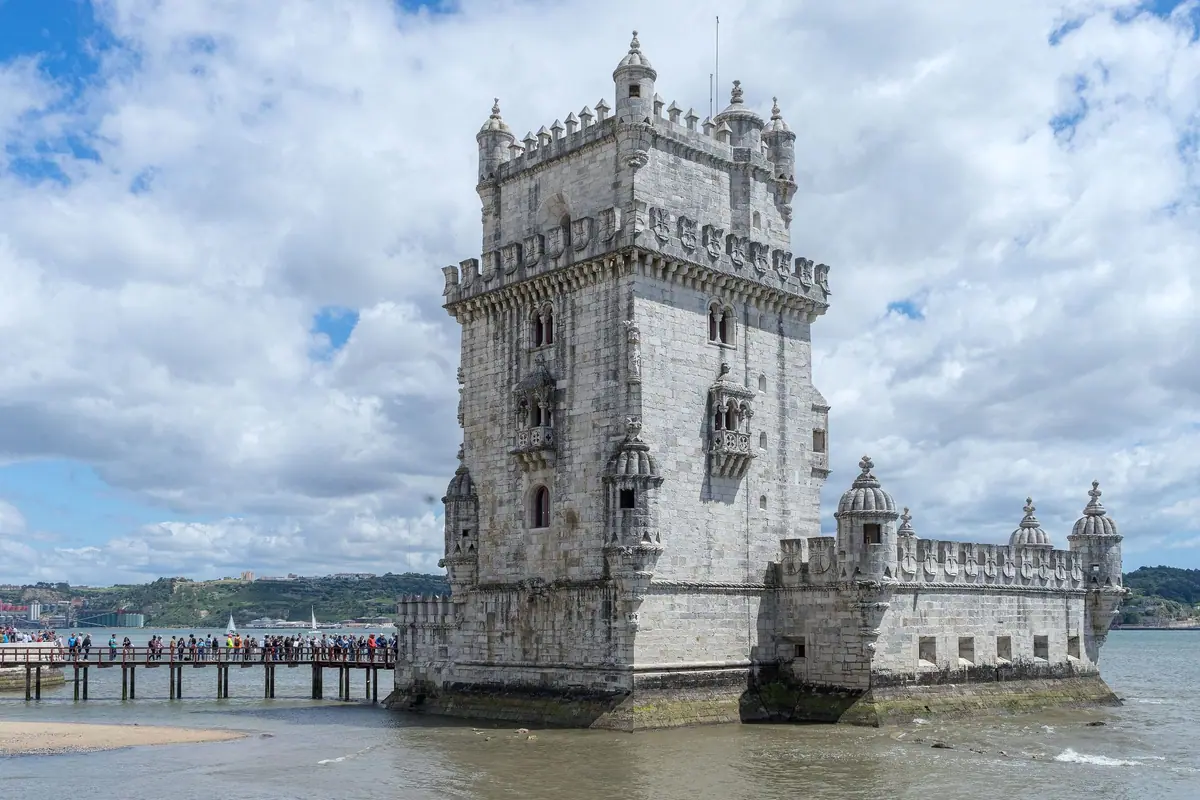 Belém Tower → About 20 minutes west along the water. It runs on half-hour slots: book one a few hours after Jerónimos.
€16.80
Card and combos
Lisboa Card options
Pick the one that fits your trip. Prices are per adult, and you choose your dates on the next page.


Tickets
Popular tickets around Lisbon
The ones other visitors book most.


