

Porto · Free for everyone
São Bento Station
São Bento Station has more than 20,000 blue-and-white azulejos, Portugal's painted tiles, on the walls of its entrance hall. The painter Jorge Colaço filled them with knights, a royal wedding and country life, under a frieze in colour. It's the largest tile display on Portugal's railways, and trains still leave from the platforms behind it. Walking in is free.
The tile panels of São Bento Station
Everything there is to see is in the entrance hall, so the visit is a slow turn on the spot. Passengers cut across the middle with their bags; stand back by the doors to take in a whole wall.
The four history panels

The big history panels face each other in pairs. On one side are the tournament of Arcos de Valdevez, a medieval joust between Portuguese and Leonese knights, and the loyal knight Egas Moniz presenting himself to the king of Castile.
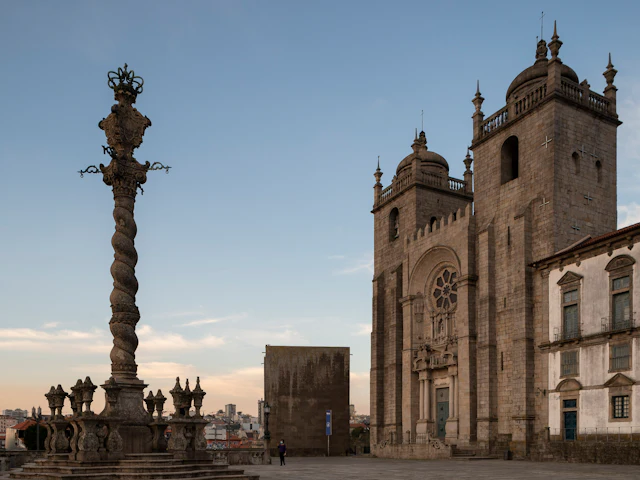
Across the hall, King João I rides into Porto with Philippa of Lancaster, his English bride, for their wedding in 1387. The wedding took place up the hill at the Cathedral, so that panel is set in the city you’re standing in.
Next to it, the Portuguese take Ceuta, in North Africa, in 1415.
The country scenes

Around the big panels, smaller ones show life in the north of Portugal. There’s the procession of Our Lady of Remedies at Lamego, the grape harvest and the reaping, the São Torcato fair near Guimarães, watermills on the river Leça and women selling chestnuts.
On the last wall are figures for Commerce, the Arts, Poetry and Music, the four seasons, Agriculture and Industry, each panel in a granite frame.
The colour frieze

Then look up. Above the blue and white, a frieze in colour runs round the hall with the history of transport. It starts with Romans, Visigoths and Arabs and ends with the steam engine and railway motifs.
São Bento Station: free entry, hours and getting there
You just walk in: there’s no ticket and nothing to book. It’s a working station, and no visiting hours are published.
- Entry
- Free
- Where
- Praça de Almeida Garrett, in the Baixa
- Metro
- São Bento, line D, linked to the hall
- Lockers
- Just past the hall: older ones take coins, newer ones take cards
- Toilets
- Paid, according to visitors
By day the hall fills with tour groups, suitcases and cameras. Visitors in 2026 found it calmer early in the morning and late in the afternoon. A reviewer who came after dark in November 2025, with the lights on, found fewer people still.
Since late 2024 a few visitors have found some panels behind protective netting. Infraestruturas de Portugal, the state company that runs the station, didn’t mention any works when it marked the station’s 110th birthday in October 2026.
In the south wing, the Time Out Market is a food hall designed by the Porto architect Eduardo Souto de Moura, open since May 2024. It serves from 10:00 to 23:00, Sunday to Thursday, and until midnight on Fridays and Saturdays.
From the platforms behind the hall, trains leave for the Douro valley. Those from Lisbon stop at Campanhã, Porto’s main station, four minutes away by local train, with one every 5 to 15 minutes.
São Bento Station and the convent it replaced
São Bento is Portuguese for St Benedict, and the station takes its name from a 16th-century Benedictine convent, São Bento de Ave-Maria, which had to come down to make room for it.
While the site waited, passengers used a temporary wooden station, opened on 7 November 1896. Work on the real one started in 1903, to a design by the Porto architect José Marques da Silva, and it opened on 5 October 1916.
By then the tiles were already up. Jorge Colaço, born in Tangier in 1868, painted the panels between 1905 and 1908, and they went onto the walls in 1915.
In 1997 the station was listed as a Property of Public Interest, with the iron train shed, the panels and the mouth of the tunnel. The panels were restored in 2010 and 2011, work that won the SOS Azulejo prize in 2013 and a Brunel Award, for railway design, in 2014.
From São Bento Station up to the Cathedral and over the river
São Bento sits at the foot of the Cathedral hill, and the metro station for line D is underneath, with a passage up to the hall. Once you’ve seen the tiles, the walk goes up first, then across the Douro.
Up the hill and over the river
-
 Porto Cathedral → The climb up the hill takes about seven minutes. One ticket covers the cloister, the museum and the tower.
€4 -
 Dom Luís I Bridge → From the Cathedral square, the top deck takes you over to Jardim do Morro, on the Gaia side, in about ten minutes.
-
 Port Wine Cellars → Down the hill on the Gaia side to the quay, for a cellar visit and a glass of port.
€22
City passes
Porto city passes
Pick the one that fits your trip. Prices are per adult, and you choose your dates on the next page.


Tickets
Popular tickets around Porto
The ones other visitors book most.


